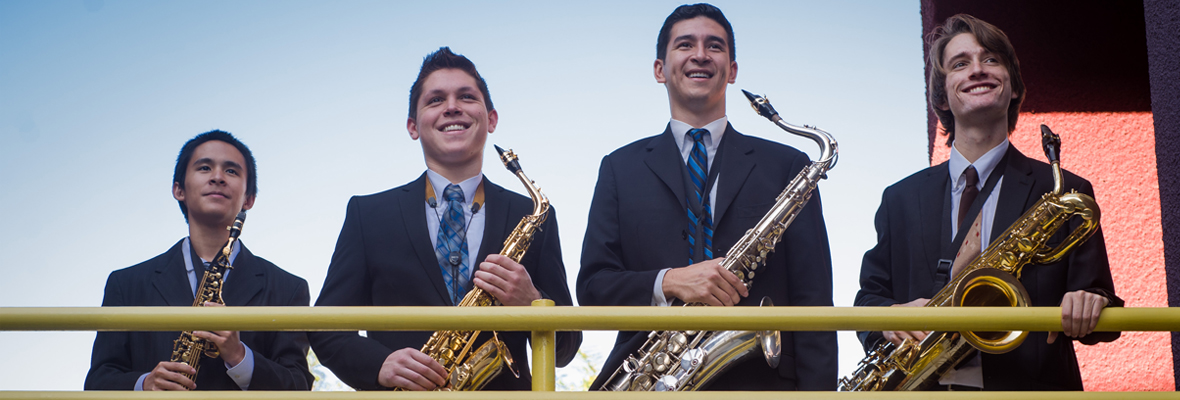
The Bob Cole Conservatory of Music offers Bachelor of Arts and Bachelor of Music degrees with concentrations in Performance, Composition, and Music Education. Options in performance include Brass, Woodwind, Percussion, Piano, Strings Voice, Opera, and Jazz. Options in Music Education include Instrumental and Choral.
Audition Dates
Auditions for the Fall semester occur in February of the same year. Auditions for the Spring semester occur in October of the previous year.
Fall 2026 Audition Dates
(All Prospective Students)
Prescreen Submission Deadline: Sunday, January 11, 2026 by 11:59pm
In-person Audition Days: Saturday, February 7, 14, & 21, 2026 (all areas except Jazz and Percussion)
Saturday, February 14, 2026 (Vocal Jazz)
Saturday, February 21, 2026 (Instrumental Jazz and Percussion)
To be considered for admission, prospective students must submit their Cal State Apply application and requisite fee during the following dates:
October 1-November 30 for admission to the next Fall
August 1-August 31 for admission to the next Spring
Scheduling an audition or submitting a prescreen application is not the same thing as applying to the university. Applying to the university and selecting "Music" does not guarantee admission as a music major.
Some undergraduate applicants may be eligible for an application fee waiver. Please visit the fee waiver site for more information.
Step 2: Review Degree Application Information
Bachelor of Music Admission Process
Bachelor of Music, Option in Performance
A Prescreening is Required
All prospective students are required to submit prescreening materials. The required repertoire for your prescreening is listed below. After reviewing your prescreen submission, we will notify you if you are selected to move on to the next stage, which is an in-person audition.
Prescreen and In-Person Audition Repertoire Requirements
Please select your area for specific repertoire and requirements:
Applicants for admission on brass instruments should be prepared to play one or more selections that best represent the applicant’s level of lyrical and technical proficiency, selected major scales, and a chromatic scale that demonstrates your range on the instrument.
Instrumental Jazz does not accept incoming students for Spring matriculation.
Prescreen Audition Repertoire by Instrument
Wind Players
Prepare two medium-tempo or up-tempo jazz standards/études in contrasting styles. Be prepared to perform the melody of the tune and improvise to the chord changes accompanied by live musicians or accompaniment tracks provided by you.
Saxophonists should be prepared to demonstrate woodwind-doubling skills on a jazz or classical étude or excerpt. Alto saxophonists should be prepared to play soprano sax and flute. Tenor saxophonists should be prepared to play clarinet and flute. Baritone saxophonists should be prepared to play bass clarinet and flute.
Guitar and Piano
Prepare two medium-tempo or up-tempo jazz standards/études in contrasting styles. Be prepared to perform the melody of the tune, perform a chord melody (guitar only), "comp" the chord changes, and improvise on the chord changes accompanied by live musicians or accompaniment tracks provided by you. Guitarists will be asked to play the written melody line; Pianists will be asked to play the written melody while comping the chord changes in the left hand.
Bass
Prepare two medium-tempo or up-tempo jazz standards/études in contrasting styles. Be prepared to perform the melody of the tune, provide a bass line (comp), and improvise to the chord changes accompanied by live musicians or accompaniment tracks provided by you.
The Jazz Studies area does not admit candidates who play electric bass only.
Drums
Prepare two medium-tempo or up-tempo jazz standards/études in contrasting styles. Be prepared to perform the tunes accompanied by live musicians or accompaniment tracks provided by you. Candidates who advance to the second part of the audition will be asked to sight read a portion of a big band chart to demonstrate your ability to play a consistent groove in the style, play set-up figures, and accurately play notated ensemble cues.
**All drum candidates are required to bring your own cymbals to the in-person audition.
Jazz Vibraphone
First-Year Students
Play the melody of, and improvise over the chord changes to two jazz standards of contrasting styles accompanied by live musicians or pre-recorded accompaniment tracks which you are required to provide.
Comp the chord changes to both tunes using two or four mallets.
Prepare an 8 measure "chord melody" of any jazz standard or one of the first 5 pieces from Vibraphone Technique: Dampening and Pedaling by David Friedman.
As part of the audition process, you will be required to sightread a jazz étude or excerpt, with a consistent time feel to evaluate rhythmic and note accuracy.
Transfer Students
Play the melody of, and improvise over the chord changes to two jazz standards of contrasting styles accompanied by live musicians or pre-recorded accompaniment tracks which you are required to provide.
Comp the chord changes to both tunes using four mallets.
Prepare a "chord melody" of an entire jazz standard and one of the first 20 pieces from Vibraphone Technique: Dampening and Pedaling by David Friedman.
As part of the audition process, you will be required to sightread a jazz étude or excerpt, with a consistent time feel to evaluate rhythmic and note accuracy.
Undergraduate and Graduate jazz studies degree programs are designed to put the finishing touches on your previously acquired jazz skills. Collegiate jazz programs are not designed to accommodate those with little or no jazz background and/or those with undeveloped music notation reading skills. Here are some general guidelines and prerequisite skills that indicate whether the Jazz Studies degree programs at "Jazz At The Beach" are a good fit for you:
Bachelor of Music in Jazz Studies Candidates
Successful candidates have a history of excellence in high school and/or community college academics, have 4-6 years of experience as leading players in their secondary school and/or community college jazz ensembles, listen to jazz regularly, are building a repertoire of jazz standards, and are able to sight read musical notation at a collegiate level.
The Jazz Studies Handbook
The Jazz Studies Handbook is now available on Canvas using your SSO login. The handbook is updated annually to publicize jazz area policies, offer helpful advice, and answer frequently asked questions from prospective and current Bob Cole Conservatory jazz majors. If you have any further questions specific to the Jazz Studies area that are not covered in this handbook, please e-mail the area director at jeff.jarvis@csulb.edu.
All of us at "Jazz At The Beach" are eager to help you realize your goals.
Vocal Jazz does not accept incoming students for Spring matriculation.
Prescreen Audition Repertoire
Your Audition Video must include two jazz standards in contrasting styles. One must be a medium or up-tempo swing. On of the pieces must include vocal improvisation.
Based on your prescreen video, you will be notified if you have been selected to advance to the next step—an in-person audition.
One classical selection. (In order to be accepted as a jazz voice major, you must possess an acceptable level of classical vocal proficiency and technique)
One medium or up-tempo swing piece (from standard jazz repertoire)
One jazz ballad or bossa nova (from standard jazz repertoire)
Improvise on at least one of your jazz selections
Sightreading one jazz excerpt (a cappella)
Repeat a random series of pitches played on the piano
Please Note
For live auditions, an accompanist will be provided. You may also use backing tracks or bring your own accompanist to play for your audition
Recording yourself during your live audition is strictly prohibited
First-Year students must complete one year of classical voice lessons, and complete a "Sophomore Hearing" in classical voice at the end of your first year. Once the Sophomore Hearing has been passed, private jazz lessons will begin. Jazz lessons usually begin at the start of sophomore year.
Keyboard Studies requires you to submit a prescreen application form in addition to a prescreen audition video to be considered for the program.
Audition Repertoire
Piano Repertoire
Three (3) works in contrasting styles demonstrating lyrical and technical accomplishment appropriate for Conservatory admission. At least one of the works must be from the Baroque or Classical era. For the performance option, the total duration must be at least twelve (12) minutes. Work(s) performed on the prescreen recording may be repeated for the audition.
Additional Notes for Piano Applicants
All music must be performed by memory
Single movements of larger works (e.g. sonatas) are allowed; several selections from a larger group (e.g. Chopin Preludes) may be counted as one work
Transcriptions, arrangements and concert paraphrases are acceptable; no simplified arrangements.
Sample Programs, representing MINIMUM level of difficulty
1. Bachelor of Music (piano performance)
J.S. Bach: Prelude and Fugue in C-sharp Major from Well-Tempered Clavier, Book 1
Liszt: Concert Etude "Un Sospiro"
Ravel: Sonatine, first movement
Haydn: Sonata in E-flat Major, Hob. XVI/49, first movement
Chopin: Ballade No. 3 in A-flat Major, Op. 47
Prokofiev: Sonata No. 3 in A Minor, Op. 28
2. Bachelor of Music (1st year non-performance degrees)
J. S. Bach: Two-Part Invention No. 8 in F Major
Mendelssohn: Song Without Words, Op. 19, No. 4
Debussy: Le petit Nègre
Clementi: Sonatina in D Major, Op. 36, No. 6, first movement
Robert Schumann: From Foreign Lands and Peoples from Scenes from Childhood, Op. 15
Kabalevsky: Variations in D Major, Op. 40
3. Bachelor of Music (junior transfer, non-performance degrees)
Beethoven: Sonata in C Minor, Op. 10, No. 1, first movement
Chopin: Polonaise in C-sharp Minor, Op. 26, No. 1
Copland: The Cat and The Mouse
J. S. Bach: French Suite No. 5 in G Major
Schubert: Impromptu in E-flat Major
Debussy: La Fille aux cheveux de lin from Preludes, Book 1
Organ Repertoire
Applicants for admission on organ should be prepared to perform a work demonstrating both musical registration and technique. This may be done with one composition or with two contrasting works. Playing from memory will be considered as denoting serious preparation.
Repertoire may include:
First-Year Students
Early baroque works, some without pedal
Bach: Little Eight Preludes and Fugues
Rheinberger: Ten Trios
Bach: Orgelbuchlein
Faulkner: Sonatas
Guilmant: Sonatas
Mendelssohn: Sonata (movements)
Dupre: Antiphons (selected)
Bingham: hymn settings
Walcha: Chorale Preludes
Wood: Folk Tune Sketches
Sophomores
Dunstable: Agincourt Hymn
Pachelbel: Toccatas
Buxtehude: Fugues and Chorales
Mendelssohn: Sonatas
Franck: Andantino or Cantabile
J.S. Bach: Swiss Fugue or Cathedral or Fantastie and Fugue
Hindemith: Sonatas I and III (movements)
Jacobi: Preludes
Walcha: Chorale Preludes
Weinberger: Bible Poems
Manz: Chorale Settings
Juniors
Baroque works of Marcello, Sweelinck, Couperin, and Daquin
Schumann: Canons
Reger:(selected pieces)
Langlais: Epilogue
Karg-Elert: Chorale Preludes
J.S. Bach: Preludes and Fugues in C Minor and F Minor
Following each semester of required private study the student must pass a performance examination before a jury composed of the studio instructor and Conservatory of Music faculty members.
Additional Organ Jury Requirements
All or portions of a work from each of the periods in music history studied during the semester. Registration, pedal dexterity, finger legato, manual changes and use of the expression pedals are essential achievements.
Pieces or études should be chosen from the following categories and need not be memorized:
Required Repertoire
Mallet Keyboard
Perform one 2-mallet solo work or étude to demonstrate musicianship, such as: Tambourin Chinois by Fritz Kriesler (arranged for xylophone by George Hamilton Green), Two: A Collection of Concert Pieces for Two-mallet Marimba Solo by Gene Koshinksi, Sonatas & Partitas for Violin or Six Suites for Cello by J.S. Bach or equivalent.
Perform one 4-mallet piece from the contemporary marimba literature, such as: A Cricket Sang and Set the Sun by Blake Tyson, Meditation and Dance by David Steinquest, Mexican Dances by Gordon Stout or similar.
Snare Drum
Perform a piece or étude in concert style from either: Tributes for Snare Drum by Ted Atkatz or 12 Etudes for Snare Drum by Jacques Delécluse
Perform a rudimental style piece, example: 14 Modern Contest Solos for Snare Drum by John Pratt
Timpani
Perform a representative piece or étude, example: Eight Pieces for Timpani by Elliot Carter, 20 Studies for Timpani by Jacques Delécluse, Etudes & Solos for Timpani or Saul Goodman’s Modern Method for Timpani or equivalent
Optional Repertoire
Excerpts
Perform excerpts form the standard orchestral repertoire on Xylophone, Snare Drum, Cymbals, Tambourine, Triangle, etc.
Applicants for admission should bring to the audition sticks, mallets, music, and any instruments beyond a marimba, vibraphone, snare drum, timpani and drum set.
Required Repertoire
Mallet Keyboard
Demonstrate 2 Octave Major Scales, Arpeggios and Chromatic Scale
Perform one 2-mallet solo work or étude to demonstrate musicianship, such as: Tambourin Chinois by Fritz Kriesler (arranged for xylophone by George Hamilton Green), Two: A Collection of Concert Pieces for Two-mallet Marimba Solo by Gene Koshinksi, Sonatas & Partitas for Violin or Six Suites for Cello by J.S. Bach or equivalent.
Perform one 4-mallet piece from the contemporary marimba literature, such as: A Cricket Sang and Set the Sun by Blake Tyson, Meditation and Dance by David Steinquest, Mexican Dances by Gordon Stout or similar.
Snare Drum
Perform a piece or étude in concert style from either: Tributes for Snare Drum by Ted Atkatz or 12 Etudes for Snare Drum by Jacques Delécluse
Perform a rudimental style piece, example: 14 Modern Contest Solos for Snare Drum by John Pratt
Demonstrate the 40 Percussive Arts Society Standard American rudiments, sight reading
Timpani
Perform a representative piece or étude, example: Eight Pieces for Timpani by Elliot Carter, 20 Studies for Timpani by Jacques Delécluse, Etudes & Solos for Timpani or Saul Goodman’s Modern Method for Timpani or equivalent
Demonstrate rolls, tuning, sight reading
Optional Repertoire
Excerpts
Perform excerpts form the standard orchestral repertoire on Xylophone, Snare Drum, Cymbals, Tambourine, Triangle, etc.
Applicants for admission should meet the following requirements:
Prepare two or three contrasting pieces. At least one piece must be classical in style. The other piece(s) may be classical or from the musical theater repertoire in the classical style
At least one of your selections must be in a language other than English
All pieces must be performed from memory
Prescreen auditions must be performed with accompaniment. While live accompaniment is preferred, recorded accompaniment is acceptable for prescreens
Applicants for admission should meet the following requirements:
Prepare two or three contrasting pieces. At least one piece must be classical in style. The other piece(s) may be classical or from the musical theater repertoire in the classical style
At least one of your selections must be in a language other than English
All pieces must be performed from memory
All pieces must be performed with accompaniment. If you are invited to an in-person audition, a pianist will be provided
Transfer applicants will undergo a brief sight-singing examination
Printed Music Requirements (In-Person Auditions Only)
Bring clean, legible printed sheet music for the pianist
Music must be a complete piano–vocal score (lead sheets are not acceptable)
Scores should be placed in a binder and organized for easy page turns
Pages should be printed clearly and, where possible, front and back
All cuts, repeats, and starting points must be clearly marked in the score
Applicants for admission on clarinet should be prepared to perform one or more selections that best represent the applicant’s level of lyrical and technical proficiency. Please use the list below to help you select a work that best showcases your abilities. These are only suggestions, feel free to choose a work not on this list.
Representative material: the student should perform works at least the equivalent of material found in Lazarus (Parts II and III), Klose, Baermann (Parts I and II), and Magnani (Parts I and II).
Repertoire may include:
Scales and Technical Studies
Chromatic Scale (from memory)
Major Scales (from memory)
Natural, Harmonic, and Melodic Minor Scales (from memory)
Applicants for admission on flute should be prepared to play one or more selections that best represent the applicant’s level of lyrical and technical proficiency and are approximately a total of 10 minutes of music. Please use the list below to help you select a work that best showcases your abilities. These are only suggestions, feel free to choose a work not on this list.
Applicants for admission on oboe should be prepared to play two contrasting selections that best represent the applicant’s level of lyrical and technical proficiency. Please use the list below to help you select a work that best showcases your abilities. These are only suggestions, feel free to choose a work not on this list.
Repertoire may include:
Method and Exercise Books
A.M.R. Barrett: Complete Oboe Method, Original Edition (Boosey and Hawkes)
H. Brod: Études et Sonates pour Hautbois, 2nd Volume (A. Leduc)
W. Ferling: 48 Famous Studies (Southern Music Co.)
G. Gillet: Studies for the Advanced Teaching of the Oboe (A. Leduc)
A. Andraud: Vade Mecum of the Oboist (Southern Music Co.)
Sonatas and Solo Works
F. Poulenc: Sonata for Oboe and Piano (Southern Music Co.)
C. Saint-Saëns: Sonata for Oboe and Piano
G. Handel: Sonata No. 1 in C minor, No. 2 in G minor
A. Vivaldi: Sonata in C minor
G.P. Telemann: Sonata in G minor
G.P. Telemann: Twelve Fantasias
E. Paladihle: Solo
E. Lutyens: Presages Op. 53
G. Guilhaud: Premiere Concertino
C. Nielsen: Romance and Humoresque
R. Gipps: The Piper of Dreams for solo oboe
M. Maxwell: Pibroch for solo oboe and drone
P. Hindemith: Sonate für Oboe und Klavier (Schott)
M. Dranishnikova: Poem for oboe and piano
K. Hoover: Sonata Op. 44
F. Onovwerosuoke: Six Sketches for Oboes and Piano
H. Dutilleux: Sonata pour Hautbois et Piano (Leduc)
B. Britten: Six Metamorphoses after Ovid
J. Brandon: Three Desert Fables
A. Morris: Four Personalities
A. Morris: Six Collision Etudes
E. Bozza: Fantasie Pastorale
W. Piston: Suite for Oboe and Piano
W.G. Still: Incantation and Dance
R. Schumann: Three Romances for oboe and piano
M. Dring: Italian Dance
M. Dring: Three Piece Suiteli
Concerti
A. Vivaldi Concerti: A minor RV 461, D Major RV 453, D minor RV 454
Applicants for admission on saxophone should prepare two contrasting selections that best represent the applicant’s level of lyrical and technical proficiency and are approximately a total of 10 minutes of music. Please use the list below to help you select a work that best showcases your abilities. These are only suggestions, feel free to choose a work not on this list. Etudes are not appropriate for this audition.
Selections marked with * are appropriate for transfer students.
All prospective students are required to submit prescreening materials. The required portfolio for your prescreening is listed below. After reviewing your prescreen submission, we will notify you if you are selected to move on to the next stage, which is an in-person audition.
Portfolio Requirements
First time, first-year applicants
Your portfolio should contain two to three recent original compositions. At least one of the compositions should be notated. The notation could be by hand or using a notation software. Other compositions could be realized by means of a digital audio workstation (DAW).
All compositions should be accompanied by recordings
It is preferred that one of the compositions be recorded live by a musician; however, electronic versions are acceptable
Composition applicants should also include a complete list of works including title, duration, instrumentation, and performances for each piece
If your portfolio is not ready at this time, we will send you reminders before the deadline.
Transfer applicants
The portfolio should contain three to five recent original notated works that show your awareness of 20th-21st century practices in composition. The notation could be by hand or using a notation software. Other compositions could be realized by means of a digital audio workstation (DAW).
All compositions should be accompanied by recordings
It is preferred that one of the compositions be recorded live by a musician; however, electronic versions are acceptable
Composition applicants should also include a complete list of works including title, duration, instrumentation, and performances for each piece
If your portfolio is not ready at this time, we will send you reminders before the deadline.
The Music Education Major
Students wishing to become teachers in K-12 public schools should audition and interview as Music Education majors. To be considered for Music Education you must pass a performance audition on your instrument.
Direct all performance audition-related questions to the area director of your specific instrument or voice. Do not contact the area director(s) of Music Education for questions about your audition.
Students who wish to be studio teachers or who plan to go directly to graduate school after their undergraduate studies would be better served with a performance degree.
A Prescreening and Music Education Interview are Required
All prospective students are required to submit prescreening materials. The required repertoire for your prescreening is listed below. After reviewing your prescreen submission, we will notify you if you are selected to move on to the next stage, which is an in-person audition.
At your in-person audition, you will also complete your Music Education interview.
Prescreen and In-Person Audition Repertoire Requirements
Please select your area for specific repertoire and requirements:
Applicants for admission on brass instruments should be prepared to play one or more selections that best represent the applicant’s level of lyrical and technical proficiency, selected major scales, and a chromatic scale that demonstrates your range on the instrument.
Instrumental Jazz does not accept incoming students for Spring matriculation.
Prescreen Audition Repertoire by Instrument
Wind Players
Prepare two medium-tempo or up-tempo jazz standards/études in contrasting styles. Be prepared to perform the melody of the tune and improvise to the chord changes accompanied by live musicians or accompaniment tracks provided by you.
Saxophonists should be prepared to demonstrate woodwind-doubling skills on a jazz or classical étude or excerpt. Alto saxophonists should be prepared to play soprano sax and flute. Tenor saxophonists should be prepared to play clarinet and flute. Baritone saxophonists should be prepared to play bass clarinet and flute.
Guitar and Piano
Prepare two medium-tempo or up-tempo jazz standards/études in contrasting styles. Be prepared to perform the melody of the tune, perform a chord melody (guitar only), "comp" the chord changes, and improvise on the chord changes accompanied by live musicians or accompaniment tracks provided by you. Guitarists will be asked to play the written melody line; Pianists will be asked to play the written melody while comping the chord changes in the left hand.
Bass
Prepare two medium-tempo or up-tempo jazz standards/études in contrasting styles. Be prepared to perform the melody of the tune, provide a bass line (comp), and improvise to the chord changes accompanied by live musicians or accompaniment tracks provided by you.
The Jazz Studies area does not admit candidates who play electric bass only.
Drums
Prepare two medium-tempo or up-tempo jazz standards/études in contrasting styles. Be prepared to perform the tunes accompanied by live musicians or accompaniment tracks provided by you. Candidates who advance to the second part of the audition will be asked to sight read a portion of a big band chart to demonstrate your ability to play a consistent groove in the style, play set-up figures, and accurately play notated ensemble cues.
**All drum candidates are required to bring your own cymbals to the in-person audition.
Jazz Vibraphone
First-Year Students
Play the melody of, and improvise over the chord changes to two jazz standards of contrasting styles accompanied by live musicians or pre-recorded accompaniment tracks which you are required to provide.
Comp the chord changes to both tunes using two or four mallets.
Prepare an 8 measure "chord melody" of any jazz standard or one of the first 5 pieces from Vibraphone Technique: Dampening and Pedaling by David Friedman.
As part of the audition process, you will be required to sightread a jazz étude or excerpt, with a consistent time feel to evaluate rhythmic and note accuracy.
Transfer Students
Play the melody of, and improvise over the chord changes to two jazz standards of contrasting styles accompanied by live musicians or pre-recorded accompaniment tracks which you are required to provide.
Comp the chord changes to both tunes using four mallets.
Prepare a "chord melody" of an entire jazz standard and one of the first 20 pieces from Vibraphone Technique: Dampening and Pedaling by David Friedman.
As part of the audition process, you will be required to sightread a jazz étude or excerpt, with a consistent time feel to evaluate rhythmic and note accuracy.
Undergraduate and Graduate jazz studies degree programs are designed to put the finishing touches on your previously acquired jazz skills. Collegiate jazz programs are not designed to accommodate those with little or no jazz background and/or those with undeveloped music notation reading skills. Here are some general guidelines and prerequisite skills that indicate whether the Jazz Studies degree programs at "Jazz At The Beach" are a good fit for you:
Bachelor of Music in Jazz Studies Candidates
Successful candidates have a history of excellence in high school and/or community college academics, have 4-6 years of experience as leading players in their secondary school and/or community college jazz ensembles, listen to jazz regularly, are building a repertoire of jazz standards, and are able to sight read musical notation at a collegiate level.
The Jazz Studies Handbook
The Jazz Studies Handbook is now available on Canvas using your SSO login. The handbook is updated annually to publicize jazz area policies, offer helpful advice, and answer frequently asked questions from prospective and current Bob Cole Conservatory jazz majors. If you have any further questions specific to the Jazz Studies area that are not covered in this handbook, please e-mail the area director at jeff.jarvis@csulb.edu.
All of us at "Jazz At The Beach" are eager to help you realize your goals.
Vocal Jazz does not accept incoming students for Spring matriculation.
Prescreen Audition Repertoire
Your Audition Video must include two jazz standards in contrasting styles. One must be a medium or up-tempo swing. On of the pieces must include vocal improvisation.
Based on your prescreen video, you will be notified if you have been selected to advance to the next step—an in-person audition.
One classical selection. (In order to be accepted as a jazz voice major, you must possess an acceptable level of classical vocal proficiency and technique)
One medium or up-tempo swing piece (from standard jazz repertoire)
One jazz ballad or bossa nova (from standard jazz repertoire)
Improvise on at least one of your jazz selections
Sightreading one jazz excerpt (a cappella)
Repeat a random series of pitches played on the piano
Please Note
For live auditions, an accompanist will be provided. You may also use backing tracks or bring your own accompanist to play for your audition
Recording yourself during your live audition is strictly prohibited
First-Year students must complete one year of classical voice lessons, and complete a "Sophomore Hearing" in classical voice at the end of your first year. Once the Sophomore Hearing has been passed, private jazz lessons will begin. Jazz lessons usually begin at the start of sophomore year.
Keyboard Studies requires you to submit a prescreen application form in addition to a prescreen audition video to be considered for the program.
Audition Repertoire
Piano Repertoire
Three (3) works in contrasting styles demonstrating lyrical and technical accomplishment appropriate for Conservatory admission. At least one of the works must be from the Baroque or Classical era. For the performance option, the total duration must be at least twelve (12) minutes. Work(s) performed on the prescreen recording may be repeated for the audition.
Additional Notes for Piano Applicants
All music must be performed by memory
Single movements of larger works (e.g. sonatas) are allowed; several selections from a larger group (e.g. Chopin Preludes) may be counted as one work
Transcriptions, arrangements and concert paraphrases are acceptable; no simplified arrangements.
Sample Programs, representing MINIMUM level of difficulty
1. Bachelor of Music (piano performance)
J.S. Bach: Prelude and Fugue in C-sharp Major from Well-Tempered Clavier, Book 1
Liszt: Concert Etude "Un Sospiro"
Ravel: Sonatine, first movement
Haydn: Sonata in E-flat Major, Hob. XVI/49, first movement
Chopin: Ballade No. 3 in A-flat Major, Op. 47
Prokofiev: Sonata No. 3 in A Minor, Op. 28
2. Bachelor of Music (1st year non-performance degrees)
J. S. Bach: Two-Part Invention No. 8 in F Major
Mendelssohn: Song Without Words, Op. 19, No. 4
Debussy: Le petit Nègre
Clementi: Sonatina in D Major, Op. 36, No. 6, first movement
Robert Schumann: From Foreign Lands and Peoples from Scenes from Childhood, Op. 15
Kabalevsky: Variations in D Major, Op. 40
3. Bachelor of Music (junior transfer, non-performance degrees)
Beethoven: Sonata in C Minor, Op. 10, No. 1, first movement
Chopin: Polonaise in C-sharp Minor, Op. 26, No. 1
Copland: The Cat and The Mouse
J. S. Bach: French Suite No. 5 in G Major
Schubert: Impromptu in E-flat Major
Debussy: La Fille aux cheveux de lin from Preludes, Book 1
Organ Repertoire
Applicants for admission on organ should be prepared to perform a work demonstrating both musical registration and technique. This may be done with one composition or with two contrasting works. Playing from memory will be considered as denoting serious preparation.
Repertoire may include:
First-Year Students
Early baroque works, some without pedal
Bach: Little Eight Preludes and Fugues
Rheinberger: Ten Trios
Bach: Orgelbuchlein
Faulkner: Sonatas
Guilmant: Sonatas
Mendelssohn: Sonata (movements)
Dupre: Antiphons (selected)
Bingham: hymn settings
Walcha: Chorale Preludes
Wood: Folk Tune Sketches
Sophomores
Dunstable: Agincourt Hymn
Pachelbel: Toccatas
Buxtehude: Fugues and Chorales
Mendelssohn: Sonatas
Franck: Andantino or Cantabile
J.S. Bach: Swiss Fugue or Cathedral or Fantastie and Fugue
Hindemith: Sonatas I and III (movements)
Jacobi: Preludes
Walcha: Chorale Preludes
Weinberger: Bible Poems
Manz: Chorale Settings
Juniors
Baroque works of Marcello, Sweelinck, Couperin, and Daquin
Schumann: Canons
Reger:(selected pieces)
Langlais: Epilogue
Karg-Elert: Chorale Preludes
J.S. Bach: Preludes and Fugues in C Minor and F Minor
Following each semester of required private study the student must pass a performance examination before a jury composed of the studio instructor and Conservatory of Music faculty members.
Additional Organ Jury Requirements
All or portions of a work from each of the periods in music history studied during the semester. Registration, pedal dexterity, finger legato, manual changes and use of the expression pedals are essential achievements.
Pieces or études should be chosen from the following categories and need not be memorized:
Required Repertoire
Mallet Keyboard
Perform one 2-mallet solo work or étude to demonstrate musicianship, such as: Tambourin Chinois by Fritz Kriesler (arranged for xylophone by George Hamilton Green), Two: A Collection of Concert Pieces for Two-mallet Marimba Solo by Gene Koshinksi, Sonatas & Partitas for Violin or Six Suites for Cello by J.S. Bach or equivalent.
Perform one 4-mallet piece from the contemporary marimba literature, such as: A Cricket Sang and Set the Sun by Blake Tyson, Meditation and Dance by David Steinquest, Mexican Dances by Gordon Stout or similar.
Snare Drum
Perform a piece or étude in concert style from either: Tributes for Snare Drum by Ted Atkatz or 12 Etudes for Snare Drum by Jacques Delécluse
Perform a rudimental style piece, example: 14 Modern Contest Solos for Snare Drum by John Pratt
Timpani
Perform a representative piece or étude, example: Eight Pieces for Timpani by Elliot Carter, 20 Studies for Timpani by Jacques Delécluse, Etudes & Solos for Timpani or Saul Goodman’s Modern Method for Timpani or equivalent
Optional Repertoire
Excerpts
Perform excerpts form the standard orchestral repertoire on Xylophone, Snare Drum, Cymbals, Tambourine, Triangle, etc.
Applicants for admission should bring to the audition sticks, mallets, music, and any instruments beyond a marimba, vibraphone, snare drum, timpani and drum set.
Required Repertoire
Mallet Keyboard
Demonstrate 2 Octave Major Scales, Arpeggios and Chromatic Scale
Perform one 2-mallet solo work or étude to demonstrate musicianship, such as: Tambourin Chinois by Fritz Kriesler (arranged for xylophone by George Hamilton Green), Two: A Collection of Concert Pieces for Two-mallet Marimba Solo by Gene Koshinksi, Sonatas & Partitas for Violin or Six Suites for Cello by J.S. Bach or equivalent.
Perform one 4-mallet piece from the contemporary marimba literature, such as: A Cricket Sang and Set the Sun by Blake Tyson, Meditation and Dance by David Steinquest, Mexican Dances by Gordon Stout or similar.
Snare Drum
Perform a piece or étude in concert style from either: Tributes for Snare Drum by Ted Atkatz or 12 Etudes for Snare Drum by Jacques Delécluse
Perform a rudimental style piece, example: 14 Modern Contest Solos for Snare Drum by John Pratt
Demonstrate the 40 Percussive Arts Society Standard American rudiments, sight reading
Timpani
Perform a representative piece or étude, example: Eight Pieces for Timpani by Elliot Carter, 20 Studies for Timpani by Jacques Delécluse, Etudes & Solos for Timpani or Saul Goodman’s Modern Method for Timpani or equivalent
Demonstrate rolls, tuning, sight reading
Optional Repertoire
Excerpts
Perform excerpts form the standard orchestral repertoire on Xylophone, Snare Drum, Cymbals, Tambourine, Triangle, etc.
Applicants for admission should meet the following requirements:
Prepare two or three contrasting pieces. At least one piece must be classical in style. The other piece(s) may be classical or from the musical theater repertoire in the classical style
At least one of your selections must be in a language other than English
All pieces must be performed from memory
Prescreen auditions must be performed with accompaniment. While live accompaniment is preferred, recorded accompaniment is acceptable for prescreens
Applicants for admission should meet the following requirements:
Prepare two or three contrasting pieces. At least one piece must be classical in style. The other piece(s) may be classical or from the musical theater repertoire in the classical style
At least one of your selections must be in a language other than English
All pieces must be performed from memory
All pieces must be performed with accompaniment. If you are invited to an in-person audition, a pianist will be provided
Transfer applicants will undergo a brief sight-singing examination
Printed Music Requirements (In-Person Auditions Only)
Bring clean, legible printed sheet music for the pianist
Music must be a complete piano–vocal score (lead sheets are not acceptable)
Scores should be placed in a binder and organized for easy page turns
Pages should be printed clearly and, where possible, front and back
All cuts, repeats, and starting points must be clearly marked in the score
Applicants for admission on clarinet should be prepared to perform one or more selections that best represent the applicant’s level of lyrical and technical proficiency. Please use the list below to help you select a work that best showcases your abilities. These are only suggestions, feel free to choose a work not on this list.
Representative material: the student should perform works at least the equivalent of material found in Lazarus (Parts II and III), Klose, Baermann (Parts I and II), and Magnani (Parts I and II).
Repertoire may include:
Scales and Technical Studies
Chromatic Scale (from memory)
Major Scales (from memory)
Natural, Harmonic, and Melodic Minor Scales (from memory)
Applicants for admission on flute should be prepared to play one or more selections that best represent the applicant’s level of lyrical and technical proficiency and are approximately a total of 10 minutes of music. Please use the list below to help you select a work that best showcases your abilities. These are only suggestions, feel free to choose a work not on this list.
Applicants for admission on oboe should be prepared to play two contrasting selections that best represent the applicant’s level of lyrical and technical proficiency. Please use the list below to help you select a work that best showcases your abilities. These are only suggestions, feel free to choose a work not on this list.
Repertoire may include:
Method and Exercise Books
A.M.R. Barrett: Complete Oboe Method, Original Edition (Boosey and Hawkes)
H. Brod: Études et Sonates pour Hautbois, 2nd Volume (A. Leduc)
W. Ferling: 48 Famous Studies (Southern Music Co.)
G. Gillet: Studies for the Advanced Teaching of the Oboe (A. Leduc)
A. Andraud: Vade Mecum of the Oboist (Southern Music Co.)
Sonatas and Solo Works
F. Poulenc: Sonata for Oboe and Piano (Southern Music Co.)
C. Saint-Saëns: Sonata for Oboe and Piano
G. Handel: Sonata No. 1 in C minor, No. 2 in G minor
A. Vivaldi: Sonata in C minor
G.P. Telemann: Sonata in G minor
G.P. Telemann: Twelve Fantasias
E. Paladihle: Solo
E. Lutyens: Presages Op. 53
G. Guilhaud: Premiere Concertino
C. Nielsen: Romance and Humoresque
R. Gipps: The Piper of Dreams for solo oboe
M. Maxwell: Pibroch for solo oboe and drone
P. Hindemith: Sonate für Oboe und Klavier (Schott)
M. Dranishnikova: Poem for oboe and piano
K. Hoover: Sonata Op. 44
F. Onovwerosuoke: Six Sketches for Oboes and Piano
H. Dutilleux: Sonata pour Hautbois et Piano (Leduc)
B. Britten: Six Metamorphoses after Ovid
J. Brandon: Three Desert Fables
A. Morris: Four Personalities
A. Morris: Six Collision Etudes
E. Bozza: Fantasie Pastorale
W. Piston: Suite for Oboe and Piano
W.G. Still: Incantation and Dance
R. Schumann: Three Romances for oboe and piano
M. Dring: Italian Dance
M. Dring: Three Piece Suiteli
Concerti
A. Vivaldi Concerti: A minor RV 461, D Major RV 453, D minor RV 454
Applicants for admission on saxophone should prepare two contrasting selections that best represent the applicant’s level of lyrical and technical proficiency and are approximately a total of 10 minutes of music. Please use the list below to help you select a work that best showcases your abilities. These are only suggestions, feel free to choose a work not on this list. Etudes are not appropriate for this audition.
Selections marked with * are appropriate for transfer students.
All prospective students are required to submit prescreening materials. You are required to submit your 500-word essay by the prescreening deadline.
The required repertoire for your prescreening is listed below. After reviewing your prescreen submission, we will notify you if you are selected to move on to the next stage, which is an in-person audition.
Prescreen and In-Person Audition Repertoire Requirements
Please select your area for specific repertoire and requirements:
Applicants for admission on brass instruments should be prepared to play one or more selections that best represent the applicant’s level of lyrical and technical proficiency, selected major scales, and a chromatic scale that demonstrates your range on the instrument.
Instrumental Jazz does not accept incoming students for Spring matriculation.
Prescreen Audition Repertoire by Instrument
Wind Players
Prepare two medium-tempo or up-tempo jazz standards/études in contrasting styles. Be prepared to perform the melody of the tune and improvise to the chord changes accompanied by live musicians or accompaniment tracks provided by you.
Saxophonists should be prepared to demonstrate woodwind-doubling skills on a jazz or classical étude or excerpt. Alto saxophonists should be prepared to play soprano sax and flute. Tenor saxophonists should be prepared to play clarinet and flute. Baritone saxophonists should be prepared to play bass clarinet and flute.
Guitar and Piano
Prepare two medium-tempo or up-tempo jazz standards/études in contrasting styles. Be prepared to perform the melody of the tune, perform a chord melody (guitar only), "comp" the chord changes, and improvise on the chord changes accompanied by live musicians or accompaniment tracks provided by you. Guitarists will be asked to play the written melody line; Pianists will be asked to play the written melody while comping the chord changes in the left hand.
Bass
Prepare two medium-tempo or up-tempo jazz standards/études in contrasting styles. Be prepared to perform the melody of the tune, provide a bass line (comp), and improvise to the chord changes accompanied by live musicians or accompaniment tracks provided by you.
The Jazz Studies area does not admit candidates who play electric bass only.
Drums
Prepare two medium-tempo or up-tempo jazz standards/études in contrasting styles. Be prepared to perform the tunes accompanied by live musicians or accompaniment tracks provided by you. Candidates who advance to the second part of the audition will be asked to sight read a portion of a big band chart to demonstrate your ability to play a consistent groove in the style, play set-up figures, and accurately play notated ensemble cues.
**All drum candidates are required to bring your own cymbals to the in-person audition.
Jazz Vibraphone
First-Year Students
Play the melody of, and improvise over the chord changes to two jazz standards of contrasting styles accompanied by live musicians or pre-recorded accompaniment tracks which you are required to provide.
Comp the chord changes to both tunes using two or four mallets.
Prepare an 8 measure "chord melody" of any jazz standard or one of the first 5 pieces from Vibraphone Technique: Dampening and Pedaling by David Friedman.
As part of the audition process, you will be required to sightread a jazz étude or excerpt, with a consistent time feel to evaluate rhythmic and note accuracy.
Transfer Students
Play the melody of, and improvise over the chord changes to two jazz standards of contrasting styles accompanied by live musicians or pre-recorded accompaniment tracks which you are required to provide.
Comp the chord changes to both tunes using four mallets.
Prepare a "chord melody" of an entire jazz standard and one of the first 20 pieces from Vibraphone Technique: Dampening and Pedaling by David Friedman.
As part of the audition process, you will be required to sightread a jazz étude or excerpt, with a consistent time feel to evaluate rhythmic and note accuracy.
Undergraduate and Graduate jazz studies degree programs are designed to put the finishing touches on your previously acquired jazz skills. Collegiate jazz programs are not designed to accommodate those with little or no jazz background and/or those with undeveloped music notation reading skills. Here are some general guidelines and prerequisite skills that indicate whether the Jazz Studies degree programs at "Jazz At The Beach" are a good fit for you:
Bachelor of Music in Jazz Studies Candidates
Successful candidates have a history of excellence in high school and/or community college academics, have 4-6 years of experience as leading players in their secondary school and/or community college jazz ensembles, listen to jazz regularly, are building a repertoire of jazz standards, and are able to sight read musical notation at a collegiate level.
The Jazz Studies Handbook
The Jazz Studies Handbook is now available on Canvas using your SSO login. The handbook is updated annually to publicize jazz area policies, offer helpful advice, and answer frequently asked questions from prospective and current Bob Cole Conservatory jazz majors. If you have any further questions specific to the Jazz Studies area that are not covered in this handbook, please e-mail the area director at jeff.jarvis@csulb.edu.
All of us at "Jazz At The Beach" are eager to help you realize your goals.
Vocal Jazz does not accept incoming students for Spring matriculation.
Prescreen Audition Repertoire
Your Audition Video must include two jazz standards in contrasting styles. One must be a medium or up-tempo swing. On of the pieces must include vocal improvisation.
Based on your prescreen video, you will be notified if you have been selected to advance to the next step—an in-person audition.
One classical selection. (In order to be accepted as a jazz voice major, you must possess an acceptable level of classical vocal proficiency and technique)
One medium or up-tempo swing piece (from standard jazz repertoire)
One jazz ballad or bossa nova (from standard jazz repertoire)
Improvise on at least one of your jazz selections
Sightreading one jazz excerpt (a cappella)
Repeat a random series of pitches played on the piano
Please Note
For live auditions, an accompanist will be provided. You may also use backing tracks or bring your own accompanist to play for your audition
Recording yourself during your live audition is strictly prohibited
First-Year students must complete one year of classical voice lessons, and complete a "Sophomore Hearing" in classical voice at the end of your first year. Once the Sophomore Hearing has been passed, private jazz lessons will begin. Jazz lessons usually begin at the start of sophomore year.
Keyboard Studies requires you to submit a prescreen application form in addition to a prescreen audition video to be considered for the program.
Audition Repertoire
Piano Repertoire
Three (3) works in contrasting styles demonstrating lyrical and technical accomplishment appropriate for Conservatory admission. At least one of the works must be from the Baroque or Classical era. For the performance option, the total duration must be at least twelve (12) minutes. Work(s) performed on the prescreen recording may be repeated for the audition.
Additional Notes for Piano Applicants
All music must be performed by memory
Single movements of larger works (e.g. sonatas) are allowed; several selections from a larger group (e.g. Chopin Preludes) may be counted as one work
Transcriptions, arrangements and concert paraphrases are acceptable; no simplified arrangements.
Sample Programs, representing MINIMUM level of difficulty
1. Bachelor of Music (piano performance)
J.S. Bach: Prelude and Fugue in C-sharp Major from Well-Tempered Clavier, Book 1
Liszt: Concert Etude "Un Sospiro"
Ravel: Sonatine, first movement
Haydn: Sonata in E-flat Major, Hob. XVI/49, first movement
Chopin: Ballade No. 3 in A-flat Major, Op. 47
Prokofiev: Sonata No. 3 in A Minor, Op. 28
2. Bachelor of Music (1st year non-performance degrees)
J. S. Bach: Two-Part Invention No. 8 in F Major
Mendelssohn: Song Without Words, Op. 19, No. 4
Debussy: Le petit Nègre
Clementi: Sonatina in D Major, Op. 36, No. 6, first movement
Robert Schumann: From Foreign Lands and Peoples from Scenes from Childhood, Op. 15
Kabalevsky: Variations in D Major, Op. 40
3. Bachelor of Music (junior transfer, non-performance degrees)
Beethoven: Sonata in C Minor, Op. 10, No. 1, first movement
Chopin: Polonaise in C-sharp Minor, Op. 26, No. 1
Copland: The Cat and The Mouse
J. S. Bach: French Suite No. 5 in G Major
Schubert: Impromptu in E-flat Major
Debussy: La Fille aux cheveux de lin from Preludes, Book 1
Organ Repertoire
Applicants for admission on organ should be prepared to perform a work demonstrating both musical registration and technique. This may be done with one composition or with two contrasting works. Playing from memory will be considered as denoting serious preparation.
Repertoire may include:
First-Year Students
Early baroque works, some without pedal
Bach: Little Eight Preludes and Fugues
Rheinberger: Ten Trios
Bach: Orgelbuchlein
Faulkner: Sonatas
Guilmant: Sonatas
Mendelssohn: Sonata (movements)
Dupre: Antiphons (selected)
Bingham: hymn settings
Walcha: Chorale Preludes
Wood: Folk Tune Sketches
Sophomores
Dunstable: Agincourt Hymn
Pachelbel: Toccatas
Buxtehude: Fugues and Chorales
Mendelssohn: Sonatas
Franck: Andantino or Cantabile
J.S. Bach: Swiss Fugue or Cathedral or Fantastie and Fugue
Hindemith: Sonatas I and III (movements)
Jacobi: Preludes
Walcha: Chorale Preludes
Weinberger: Bible Poems
Manz: Chorale Settings
Juniors
Baroque works of Marcello, Sweelinck, Couperin, and Daquin
Schumann: Canons
Reger:(selected pieces)
Langlais: Epilogue
Karg-Elert: Chorale Preludes
J.S. Bach: Preludes and Fugues in C Minor and F Minor
Following each semester of required private study the student must pass a performance examination before a jury composed of the studio instructor and Conservatory of Music faculty members.
Additional Organ Jury Requirements
All or portions of a work from each of the periods in music history studied during the semester. Registration, pedal dexterity, finger legato, manual changes and use of the expression pedals are essential achievements.
Pieces or études should be chosen from the following categories and need not be memorized:
Required Repertoire
Mallet Keyboard
Perform one 2-mallet solo work or étude to demonstrate musicianship, such as: Tambourin Chinois by Fritz Kriesler (arranged for xylophone by George Hamilton Green), Two: A Collection of Concert Pieces for Two-mallet Marimba Solo by Gene Koshinksi, Sonatas & Partitas for Violin or Six Suites for Cello by J.S. Bach or equivalent.
Perform one 4-mallet piece from the contemporary marimba literature, such as: A Cricket Sang and Set the Sun by Blake Tyson, Meditation and Dance by David Steinquest, Mexican Dances by Gordon Stout or similar.
Snare Drum
Perform a piece or étude in concert style from either: Tributes for Snare Drum by Ted Atkatz or 12 Etudes for Snare Drum by Jacques Delécluse
Perform a rudimental style piece, example: 14 Modern Contest Solos for Snare Drum by John Pratt
Timpani
Perform a representative piece or étude, example: Eight Pieces for Timpani by Elliot Carter, 20 Studies for Timpani by Jacques Delécluse, Etudes & Solos for Timpani or Saul Goodman’s Modern Method for Timpani or equivalent
Optional Repertoire
Excerpts
Perform excerpts form the standard orchestral repertoire on Xylophone, Snare Drum, Cymbals, Tambourine, Triangle, etc.
Applicants for admission should bring to the audition sticks, mallets, music, and any instruments beyond a marimba, vibraphone, snare drum, timpani and drum set.
Required Repertoire
Mallet Keyboard
Demonstrate 2 Octave Major Scales, Arpeggios and Chromatic Scale
Perform one 2-mallet solo work or étude to demonstrate musicianship, such as: Tambourin Chinois by Fritz Kriesler (arranged for xylophone by George Hamilton Green), Two: A Collection of Concert Pieces for Two-mallet Marimba Solo by Gene Koshinksi, Sonatas & Partitas for Violin or Six Suites for Cello by J.S. Bach or equivalent.
Perform one 4-mallet piece from the contemporary marimba literature, such as: A Cricket Sang and Set the Sun by Blake Tyson, Meditation and Dance by David Steinquest, Mexican Dances by Gordon Stout or similar.
Snare Drum
Perform a piece or étude in concert style from either: Tributes for Snare Drum by Ted Atkatz or 12 Etudes for Snare Drum by Jacques Delécluse
Perform a rudimental style piece, example: 14 Modern Contest Solos for Snare Drum by John Pratt
Demonstrate the 40 Percussive Arts Society Standard American rudiments, sight reading
Timpani
Perform a representative piece or étude, example: Eight Pieces for Timpani by Elliot Carter, 20 Studies for Timpani by Jacques Delécluse, Etudes & Solos for Timpani or Saul Goodman’s Modern Method for Timpani or equivalent
Demonstrate rolls, tuning, sight reading
Optional Repertoire
Excerpts
Perform excerpts form the standard orchestral repertoire on Xylophone, Snare Drum, Cymbals, Tambourine, Triangle, etc.
Applicants for admission should meet the following requirements:
Prepare two or three contrasting pieces. At least one piece must be classical in style. The other piece(s) may be classical or from the musical theater repertoire in the classical style
At least one of your selections must be in a language other than English
All pieces must be performed from memory
Prescreen auditions must be performed with accompaniment. While live accompaniment is preferred, recorded accompaniment is acceptable for prescreens
Applicants for admission should meet the following requirements:
Prepare two or three contrasting pieces. At least one piece must be classical in style. The other piece(s) may be classical or from the musical theater repertoire in the classical style
At least one of your selections must be in a language other than English
All pieces must be performed from memory
All pieces must be performed with accompaniment. If you are invited to an in-person audition, a pianist will be provided
Transfer applicants will undergo a brief sight-singing examination
Printed Music Requirements (In-Person Auditions Only)
Bring clean, legible printed sheet music for the pianist
Music must be a complete piano–vocal score (lead sheets are not acceptable)
Scores should be placed in a binder and organized for easy page turns
Pages should be printed clearly and, where possible, front and back
All cuts, repeats, and starting points must be clearly marked in the score
Applicants for admission on clarinet should be prepared to perform one or more selections that best represent the applicant’s level of lyrical and technical proficiency. Please use the list below to help you select a work that best showcases your abilities. These are only suggestions, feel free to choose a work not on this list.
Representative material: the student should perform works at least the equivalent of material found in Lazarus (Parts II and III), Klose, Baermann (Parts I and II), and Magnani (Parts I and II).
Repertoire may include:
Scales and Technical Studies
Chromatic Scale (from memory)
Major Scales (from memory)
Natural, Harmonic, and Melodic Minor Scales (from memory)
Applicants for admission on flute should be prepared to play one or more selections that best represent the applicant’s level of lyrical and technical proficiency and are approximately a total of 10 minutes of music. Please use the list below to help you select a work that best showcases your abilities. These are only suggestions, feel free to choose a work not on this list.
Applicants for admission on oboe should be prepared to play two contrasting selections that best represent the applicant’s level of lyrical and technical proficiency. Please use the list below to help you select a work that best showcases your abilities. These are only suggestions, feel free to choose a work not on this list.
Repertoire may include:
Method and Exercise Books
A.M.R. Barrett: Complete Oboe Method, Original Edition (Boosey and Hawkes)
H. Brod: Études et Sonates pour Hautbois, 2nd Volume (A. Leduc)
W. Ferling: 48 Famous Studies (Southern Music Co.)
G. Gillet: Studies for the Advanced Teaching of the Oboe (A. Leduc)
A. Andraud: Vade Mecum of the Oboist (Southern Music Co.)
Sonatas and Solo Works
F. Poulenc: Sonata for Oboe and Piano (Southern Music Co.)
C. Saint-Saëns: Sonata for Oboe and Piano
G. Handel: Sonata No. 1 in C minor, No. 2 in G minor
A. Vivaldi: Sonata in C minor
G.P. Telemann: Sonata in G minor
G.P. Telemann: Twelve Fantasias
E. Paladihle: Solo
E. Lutyens: Presages Op. 53
G. Guilhaud: Premiere Concertino
C. Nielsen: Romance and Humoresque
R. Gipps: The Piper of Dreams for solo oboe
M. Maxwell: Pibroch for solo oboe and drone
P. Hindemith: Sonate für Oboe und Klavier (Schott)
M. Dranishnikova: Poem for oboe and piano
K. Hoover: Sonata Op. 44
F. Onovwerosuoke: Six Sketches for Oboes and Piano
H. Dutilleux: Sonata pour Hautbois et Piano (Leduc)
B. Britten: Six Metamorphoses after Ovid
J. Brandon: Three Desert Fables
A. Morris: Four Personalities
A. Morris: Six Collision Etudes
E. Bozza: Fantasie Pastorale
W. Piston: Suite for Oboe and Piano
W.G. Still: Incantation and Dance
R. Schumann: Three Romances for oboe and piano
M. Dring: Italian Dance
M. Dring: Three Piece Suiteli
Concerti
A. Vivaldi Concerti: A minor RV 461, D Major RV 453, D minor RV 454
Applicants for admission on saxophone should prepare two contrasting selections that best represent the applicant’s level of lyrical and technical proficiency and are approximately a total of 10 minutes of music. Please use the list below to help you select a work that best showcases your abilities. These are only suggestions, feel free to choose a work not on this list. Etudes are not appropriate for this audition.
Selections marked with * are appropriate for transfer students.